
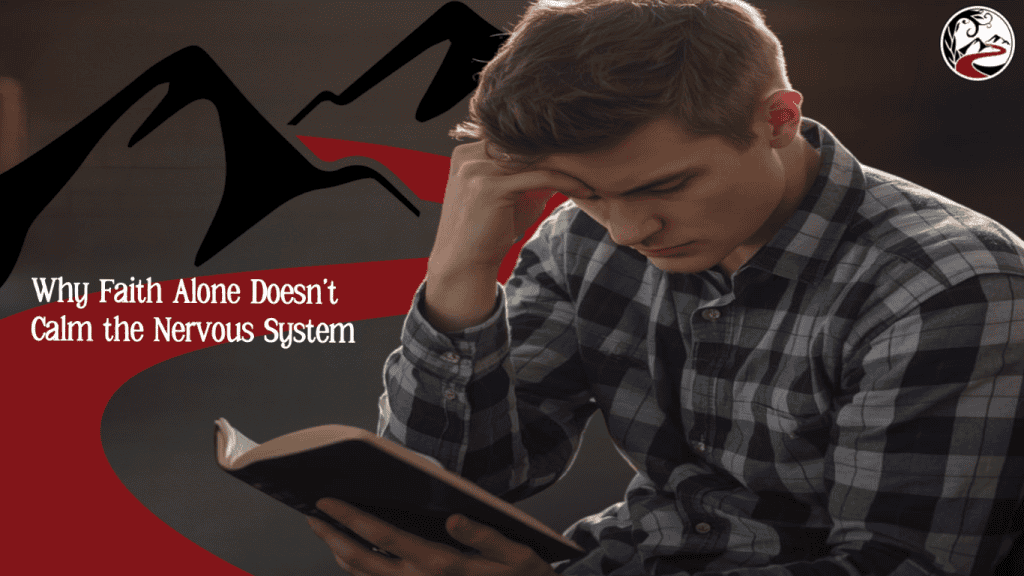
Many people of faith are confused by their own experience.
They love God.
They pray sincerely.
They believe Scripture deeply.
And yet their body remains anxious, shut down, or on edge.
This disconnect often leads to quiet shame: If my faith were real enough, my body would cooperate.
But the nervous system does not respond to belief alone. It responds to perceived safety.
Belief and Biology Are Not Opponents
Faith shapes meaning.
The nervous system shapes survival.
One speaks in truth and hope.
The other speaks in threat and protection.
When someone has lived through chronic stress, emotional unpredictability, or relational harm, their body has learned early how to stay alive. Those patterns do not disappear at conversion, baptism, or prayer. They are not erased by sincerity.
This does not mean faith is insufficient.
It means faith was never designed to bypass embodiment.
Why “Knowing Better” Doesn’t Change the Body
Neuroscience shows us that survival responses operate beneath conscious awareness. A person
can know they are safe while their body still reacts as if danger is near.
This is why:
- Worship can feel overwhelming
- Silence can trigger anxiety
- Conflict feels physically threatening
- Rest feels unsafe
The body is not arguing with God.
It is responding to history.
Where Healing Actually Begins
Healing begins when faith and the body stop competing for authority.
When spiritual life allows room for physical responses.
When emotional reactions are interpreted with compassion instead of correction.
When safety—not performance—becomes the foundation.
This is the space the P.A.T.H. Model™ was created to hold: a place where faith and neuroscience speak the same language instead of canceling each other out.