
A soul-attuned, neuroscience-informed intervention.

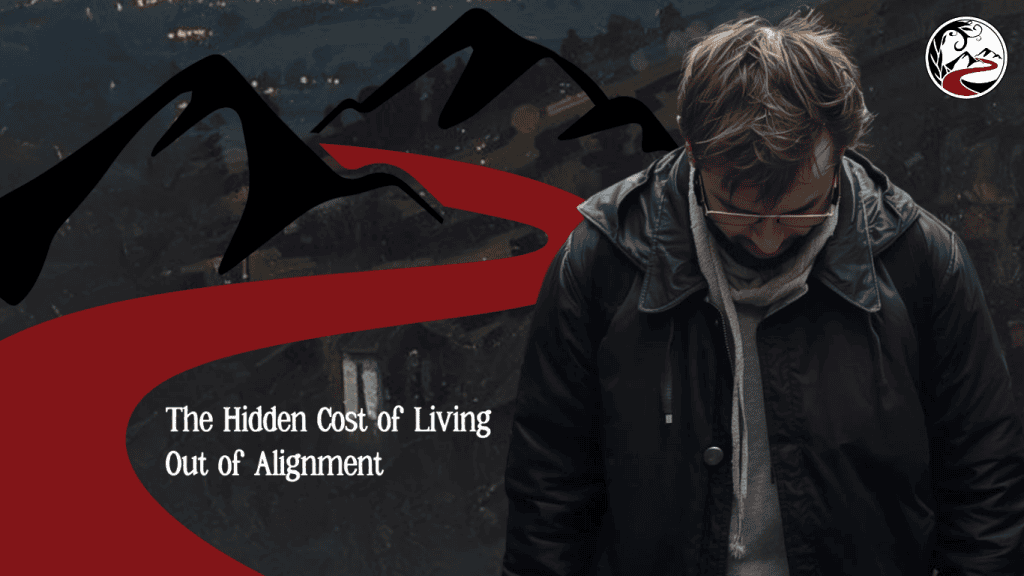
The Hidden Cost of Living Out of Alignment (And Why So Many Faithful People Exhausted)

Many people doing “all the right things” still feel deeply tired.

Not physically.
Existentially.

They serve.
They give.
They show up.
They stay faithful.

And yet something feels off.

Exhaustion Is Often an Integrity Problem, Not an Energy Problem

When your outer life consistently contradicts your inner truth, the nervous system pays the price.

This kind of exhaustion shows up as:

  • Chronic guilt without clarity
  • Resentment toward responsibilities you once embraced
  • Feeling disconnected from God despite obedience
  • A sense that you’re living someone else’s life

This isn’t rebellion.
It’s misalignment.

Why Alignment Is So Difficult in Faith Spaces

Many faith environments unintentionally reward self-abandonment:

  • Sacrifice without discernment
  • Obedience without reflection
  • Service without consent.

Over time, people learn to confuse holiness with disappearance.

But alignment is not selfishness.
It is integrity.

It is the process of allowing your values, identity, and actions to tell the same story.

What Changes When Alignment Is Restored

When alignment returns, people don’t necessarily change churches, jobs, or relationships overnight.

What changes first is internal coherence.

Decisions feel cleaner.
Guilt becomes informative instead of crushing.
Faith feels rooted rather than forced.

This is not about doing less.
It’s about living truer.
Share with those who might need it:
Facebook
Threads
Email
X
LinkedIn

Walk the PATH With Us

Get insights on faith, neuroscience, and healing—straight to your inbox.

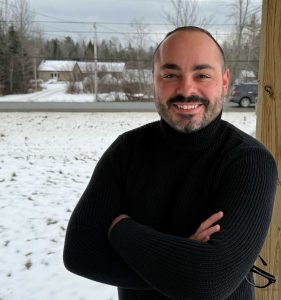
Picture of Dr. Jack Gatti Hilton, DSW, LCSW

Dr. Jack Gatti Hilton, DSW, LCSW

Dr. Jack Gatti Hilton, DSW, LCSW is the founder of The P.A.T.H. Model™, a faith-based, neuroscience-informed framework for healing. He trains and consults with clinicians, pastors, and leaders to help bridge faith, mental health, and soul work.

Table of Contents

Dr. Jack Gatti Hilton, DSW, LCSW

Jack is the founder of The P.A.T.H. Model™, a faith-based, neuroscience-informed framework that bridges soul work and mental health. As a licensed clinical social worker, educator, and trauma specialist, Jack is passionate about helping individuals, clinicians, and communities move from fragmentation to wholeness. Through training, consultation, and speaking, he equips others to integrate Presence, Alignment, Truth, and Healing into their work and lives.

Other Insights You Might Like

From Frustration to Framework

From Frustration to Framework: The Clinical Problem the P.A.T.H. Model™ Was Built to Solve

Clinical frameworks rarely emerge from theoretical elegance. More often, they emerge from a practitioner’s repeated encounter with a problem that existing models cannot adequately address. The P.A.T.H. Model™, Presence, Alignment, Truth, Healing,...

Read More

Positionality Is Not a Disclaimer

Positionality Is Not a Disclaimer: Why Clinician Self-Awareness is a Clinical Skill

Social work education has long emphasized self-awareness as a professional value. What has been slower to articulate is that positionality, the set of social, cultural, and experiential locations a clinician occupies, is...

Read More

the P.A.T.H. Model™ is Built on Interpretivism

Why the P.A.T.H. Model™ is Built on Interpretivism and Why That Choice is Clinical, Not Philosophical

Clinical research operates within paradigms, assumptions about what counts as real, what counts as knowledge, and what counts as valid evidence. These assumptions are rarely made explicit, but they shape everything: the...

Read More

The Spiritual Competency Gap

The Spiritual Competency Gap: What the Research Demands from Clinicians

There is a measurable disconnect between the populations clinicians serve and the training they receive. Research consistently shows that more than 60% of social workers report limited ability to incorporate clients’ religious...

Read More

Shame Is Not Conviction: How Shame Rewrites Identity Without Our Consent

Many people believe shame is a sign of moral awareness. In reality, shame is a protective response learned in environments where acceptance is felt conditional. How Shame Forms Shame is not taught through words...

Read More

Why Faith Alone Doesn’t Calm the Nervous System (And Why That’s Not a Failure Belief)

Many people of faith are confused by their own experience. They love God.They pray sincerely.They believe Scripture deeply. And yet their body remains anxious, shut down, or on edge. This disconnect often...

Read More

Live Training Dates Are Open!

Learn the P.A.T.H. Model in a live, guided session.