Many people in faith-based communities struggle to engage with mental health support—not because they don’t need it, but because it often feels misaligned with their beliefs.
Some are taught that emotional struggles reflect weak faith. Others are discouraged from seeking help outside of spiritual practices.
This creates a gap where people either avoid care entirely or enter it feeling guarded, misunderstood, or ashamed.
Over time, this can lead to isolation, prolonged suffering, and missed opportunities for real support.
The P.A.T.H. Model® was created in response to this gap.

Instead of asking people to choose between their faith and their healing, it offers a way to integrate both.
The model translates evidence-based principles into language that feels accessible and meaningful within faith-based contexts—making it easier for people to engage, stay, and grow.
It provides a structured, practical approach that clinicians, leaders, and helpers can actually use in real conversations and real settings.
Understanding inner conflict and integration, helping people explore the different parts of themselves with compassion, without judgment or shame.
Honoring spiritual depth and the sacred in healing — seeing each person’s growth as both psychological and spiritual.
Fostering agency, resilience, and meaningful goals — helping clients and leaders reframe struggle as an opportunity for growth and renewed purpose.

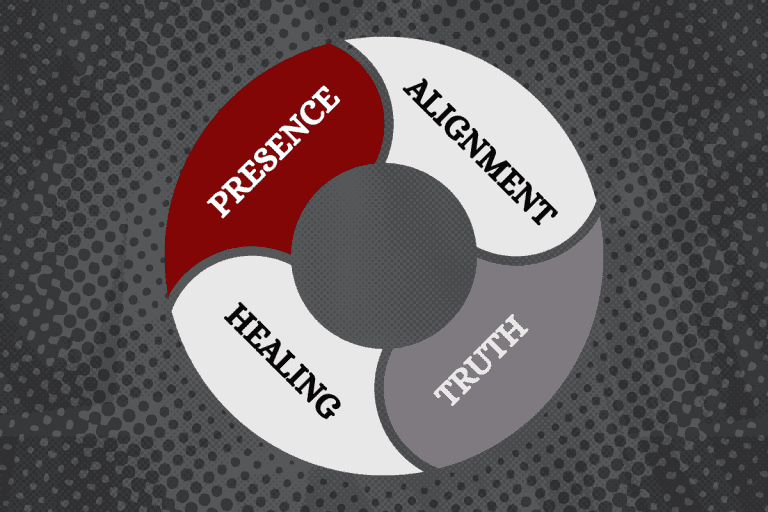
These four movements are more than concepts — they’re practices rooted in clinical wisdom and spiritual truth. We draw from Internal Family Systems to understand inner conflict, Transpersonal Theory to honor spiritual depth, and Hope Theory to help people see a way forward. Together, these foundations allow Presence, Alignment, Truth, and Healing to move beyond concepts into lived experience.
Learning to stay with what is real.
This involves slowing down, increasing awareness, and allowing emotional experiences to be acknowledged without judgment or avoidance.

Reconnecting with values, identity, and purpose.
This stage helps individuals examine whether how they’re living reflects what they truly believe and value.
Confronting distortions, shame, and false beliefs.
Here, individuals begin to challenge internal narratives shaped by fear, stigma, or misapplied beliefs—replacing them with clarity and compassion.
Integrating pain into growth and forward movement.
Rather than “fixing” what is broken, healing becomes about integration, wholeness, and living from a place of grounded clarity.

Reconnecting with values, identity, and purpose.
This stage helps individuals examine whether how they’re living reflects what they truly believe and value.

Confronting distortions, shame, and false beliefs.
Here, individuals begin to challenge internal narratives shaped by fear, stigma, or misapplied beliefs—replacing them with clarity and compassion.

Integrating pain into growth and forward movement.
Rather than “fixing” what is broken, healing becomes about integration, wholeness, and living from a place of grounded clarity.
The P.A.T.H. Model® bridges clinical insight and spiritual care in a way that feels accessible, especially for those hesitant about therapy. It was intentionally developed to reduce mental health stigma in Christian communities by reframing therapy as a sacred process.
By combining insights from Internal Family Systems, Transpersonal Theory, and Hope Theory, it invites both emotional and spiritual transformation. Clients and leaders experience safety, clarity, and compassion — moving from survival to connection and from overwhelm to peace.


This model stands apart because it does not ask people to choose between faith and healing—it creates alignment between them.
Spiritually integrated but never preachy.
The model respects faith while remaining trauma-informed and inclusive of diverse worldviews.
Trauma-informed and hope-centered.
It grounds spiritual growth in neuroscience and compassion, helping people heal without shame.
Adaptable across settings.
Flexible enough to equip Christian communities, secular leaders, and even first responders.
Bridges science and soul.
Rather than choosing between psychology or theology, P.A.T.H. unites them into one cohesive, healing language.
These distinctives make the P.A.T.H. Model® a movement — not just a method — for those seeking transformation that honors both soul and science.
The P.A.T.H. Model® offers a structured yet flexible framework for integrating spirituality and neuroscience in ethical, evidence-informed care. It provides therapists of all backgrounds — whether faith-oriented or secular — a common language for addressing inner conflict, shame, and meaning-making with cultural and spiritual sensitivity.
Pastors, chaplains, and ministry leaders use the P.A.T.H. framework to strengthen emotional and spiritual well-being within their communities. It helps reduce burnout, moral injury, and fear-based leadership by restoring alignment between mission, values, and lived experience.
Police officers, firefighters, EMTs, corrections officers, and healthcare professionals can use the P.A.T.H. Model® to process emotional fatigue, moral injury, and the stress of high-intensity service work. The framework helps restore clarity, resilience, and emotional balance without stigma or judgment.
Even outside therapy, the P.A.T.H. principles can help people facing life transitions, spiritual confusion, or emotional exhaustion. Our coaching offerings help individuals move forward with faith, truth, and identity.
We believe in deep learning over mass marketing. That’s why we preserve the model’s soul by offering guided, application-based training — not open-access certifications.
All trainings are offered via invitation, mentorship, or structured application. This ensures clarity, integrity, and accountability.
For LCSWs, LMFTs, and licensed clinicians to use the model ethically within therapy.
For pastors, small group leaders, peer mentors, and faith-based staff working in non-clinical settings.
Individuals may receive soul-attuned coaching, but we do not certify external P.A.T.H. coaches.
If the P.A.T.H. Model® resonates with the kind of work you want to offer, P.A.T.H. Foundations™ is a helpful next step.
This self-paced course walks through the four core movements of the model: Presence, Alignment, Truth, and Healing. It also includes applied case study material and introductory assessment tools to help you see how the model can be used with care and ethical awareness.